Best craft kits for beginners should remove friction, not create a scavenger hunt. The most satisfying kits give you a clear first result, understandable instructions, enough material to recover from a small mistake, and an honest list of anything you still need.
That is why “best” cannot mean one universal box. A relaxing watercolor kit, a structured embroidery kit, and a quick paper-craft kit serve different beginners. The best craft kits for beginners match the person’s interests, skill level, available time, and desired finished project.
Quick Answer: Choose a kit with one defined project, a photographed finished result, step-by-step instructions, a complete contents list, properly labeled materials, and no surprise specialist equipment. Avoid kits that rely on heat, exposed blades, resin, solvents, aerosols, strong magnets, or accessible button cells.
Best Craft Kits for Beginners: Match the Kit to the Experience You Want
Before comparing brands, decide what kind of creative session sounds enjoyable. Do you want a quick finish, a quiet repetitive activity, a giftable object, a piece of decor, or a skill you can continue after the kit is empty?
Use these five questions:
- How much uninterrupted time do I realistically have?
- Do I prefer following a pattern or making design choices?
- Do I want a finished object, a reusable skill, or both?
- Is my workspace temporary, shared, or permanent?
- Will I enjoy buying refills after the first project?
The answers narrow the field much faster than scrolling through hundreds of colorful boxes.
For the broader supply system behind these projects, read the complete guide to DIY tools and craft supplies.
1. Watercolor Starter Kits for a Low-Pressure First Session
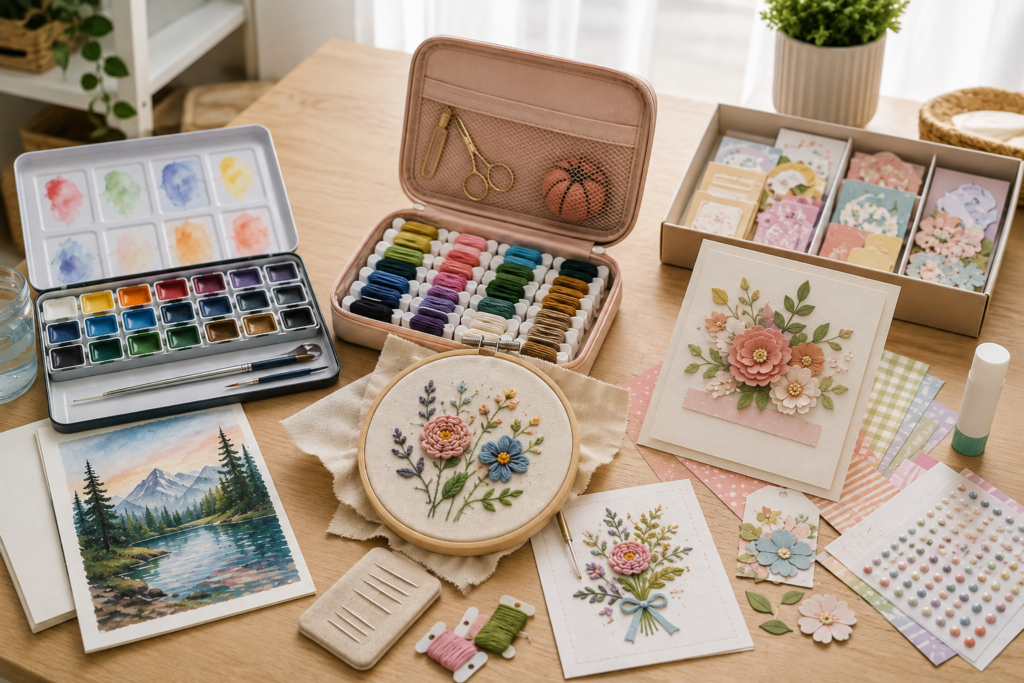
A beginner watercolor kit can be a gentle introduction because the basic setup is compact and cleanup is usually straightforward when the materials are water-based and used as labeled. Look for a focused palette, a few different brush shapes, suitable paper, and a tutorial that demonstrates simple washes and shapes.
The paper matters. A kit with many colors but unsuitable paper may feel less complete than a smaller set with a surface designed for the included paint. Check whether the photographed project can be completed with the quantity and paper size provided.
Best for:
- Beginners who enjoy color exploration
- Small desks and temporary workspaces
- People who want to continue with affordable refills
Check before buying:
- “Conforms to ASTM D-4236” labeling where applicable
- Clear paint and paper specifications
- A stable palette or mixing area
- Instructions that show the actual included materials
Choose only products whose labels and age guidance match the intended user. The ACMI certified-product search can provide an additional verification point for art materials.
2. Paper-Craft and Card-Making Kits for Quick Wins
Paper kits can produce a finished result in a single session, which makes them motivating for beginners. A good kit organizes the project into layers: base cards or paper, decorative elements, a simple adhesive intended for the materials, and a visual guide.
For this TakeDIY shortlist, favor kits with pre-cut or peel-and-stick components. Do not select boxes that require exposed blades, heated adhesive tools, or aerosol products.
Best for:
- A quick completed project
- Handmade notes, tags, or simple decor
- Shared creative sessions
Check before buying:
- Number and size of finished projects
- Whether envelopes, adhesive, and embellishments are included
- Whether the images show the exact kit contents
- Whether replacement paper sizes are easy to find
To keep the project useful after the kit is finished, connect it with creative DIY gift wrap and reuse leftover paper elements for tags or labels.
3. Beginner Embroidery Kits for a Repeatable Skill
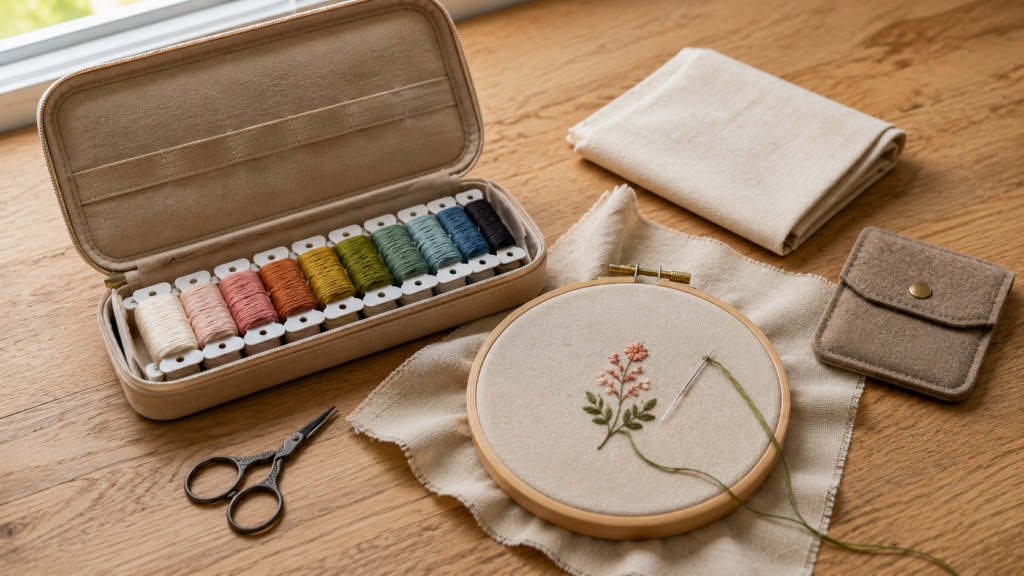
Embroidery kits are attractive because the finished piece and the learning process happen together. A strong beginner kit includes fabric, thread sorted by color, a hoop when needed, a pattern, clear stitch diagrams, and secure storage for the included needle.
Needles require careful handling and storage. Follow the age guidance and instructions supplied with the kit, keep the work area orderly, and account for every needle before putting the project away.
Best for:
- People who enjoy calm, repeated movements
- A portable project with a defined pattern
- Beginners who want a skill that continues beyond one kit
Check before buying:
- The pattern difficulty and finished dimensions
- Whether the design is pre-printed, transferable, or counted
- Whether instructions explain each required stitch
- Whether enough thread is included for normal beginner variation
TakeDIY already has a step-by-step starting point in DIY Embroidery for Beginners.
4. Macramé and Knotting Kits for Tactile Decor
Macramé kits turn a small number of materials into a decorative object through repeated knots. They work best when the cord is prepared in clearly labeled lengths and the guide shows each knot from the maker’s point of view.
Select a small tabletop or lightweight decorative project. Avoid kits that require ceiling work, heavy mounting, complex installation, or specialist hardware. The finished object should have a clear intended use and installation instructions.
Best for:
- Learners who prefer hands-on repetition
- Neutral or textured home decor
- A project that does not require paint
Check before buying:
- Finished dimensions and cord material
- Whether lengths are pre-measured
- Whether the support piece is included
- Whether the mounting method is appropriate for your space
A clear photo of each stage is more valuable than a beautifully styled image that hides the knot structure.
5. Stamping Kits With Water-Based Inks
Stamping offers quick visual feedback and can support cards, gift tags, paper labels, and simple textile projects when the products are intended for that surface. A beginner kit should keep the number of stamp shapes manageable and identify whether the ink is washable, permanent, or surface-specific.
For the first TakeDIY product selection, focus on water-based, properly labeled ink products. Exclude solvent-based inks, aerosols, and supplies with unclear safety information.
Best for:
- Pattern lovers
- Fast paper projects
- Beginners who want reusable components
Check before buying:
- Ink type and compatible surfaces
- Stamp size relative to the project
- Cleaning instructions
- Replacement ink-pad availability
Do not apply craft inks to skin or food-contact surfaces unless the product is specifically made and labeled for that use.
6. Paint-by-Number Kits for a Clearly Guided Result
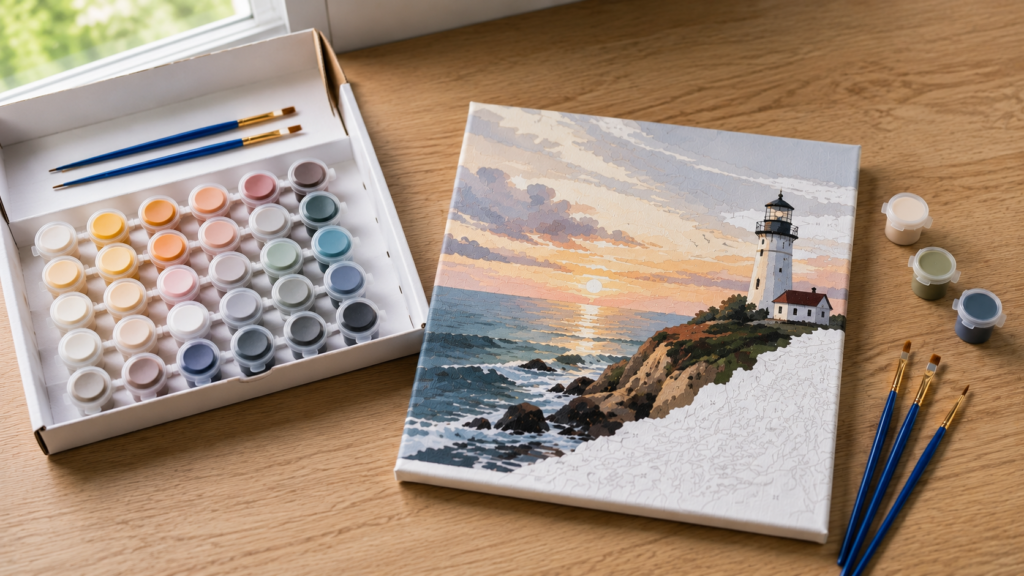
Paint-by-number kits suit beginners who want a defined result and a sequence that is easy to resume. The image should be appealing enough to motivate completion, but the practical details matter: print clarity, paint labeling, brush variety, and whether the canvas arrives flat or rolled.
Favor water-based creative paints with clear labeling. Avoid aerosol finishes, solvent-based extras, and kits whose instructions rely on unrelated household chemicals.
Best for:
- A structured project with minimal design decisions
- Decor that can be completed across several sessions
- Learners who like visible progress
Check before buying:
- Finished size and image complexity
- Legibility of the numbered areas
- Whether paint containers are clearly identified
- Whether the kit includes enough paint for the design
- Whether a frame or hanging hardware is actually included
If the goal is broader decor inspiration rather than one fixed image, compare the kit with TakeDIY’s DIY wall decor ideas.
7. Air-Dry Modeling Kits for Three-Dimensional Creativity
An air-dry modeling kit can be engaging for beginners who prefer shaping objects rather than working on a flat surface. Choose a kit specifically labeled for consumer craft use, with clear age guidance, storage directions, and a project that dries without an oven or heated tool.
The kit should explain how much material is included, the approximate size of the intended pieces, and the correct cleanup method. Small containers and work mats help keep the project organized.
Best for:
- Tactile, open-ended creativity
- Small decorative objects
- Beginners who enjoy shaping more than drawing
Check before buying:
- Complete material and warning labels
- Drying and storage instructions
- Whether color is included or requires a separate, suitable product
- Whether the final object is decorative rather than food-contact
Do not treat a decorative craft material as a cosmetic, food-safe, or body-safe product unless its labeling explicitly supports that use.
The Kit-Completeness Test
A promising product can still be incomplete. Before adding an affiliate link, compare the listing with this checklist:
- One clearly defined beginner project
- A contents photo that matches the written list
- Instructions in an accessible format
- Enough core material to complete the stated project
- No unidentified substances or unlabeled containers
- No essential specialist item hidden under “materials not included”
- Finished dimensions and expected project format
- Storage instructions for unfinished work
- Current seller, variant, availability, and return information
Write down every extra item the user must provide. A kit is not truly convenient if the hidden extras cost more or require a second shopping trip.
How TakeDIY Should Compare Products
For each craft type, compare up to three genuinely different candidates: an accessible entry option, a more complete option, and a compact or giftable option. Do not fill the shortlist with near-identical private-label boxes.
Score each candidate on:
- Match with the article’s promise
- Completeness and clarity
- Proper labeling and age guidance
- Seller and listing stability
- Recent review patterns
- Availability of refills
- Value relative to the finished project
- Safety or recall concerns
Any unresolved safety concern should override the commercial score. Check the CPSC recall database on the verification date and remove recalled or ambiguously listed products.
Common Beginner-Kit Traps
The giant piece count
A high number can include tiny duplicates, disposable components, or items unrelated to the main project. Count useful categories, not every individual piece.
The styled photo that is not the kit
Lifestyle images may include frames, furniture, tools, or decorations that are not supplied. The written contents list is the reference.
The one-line instruction sheet
A beginner kit needs more than a materials list. Look for progressive steps, clear images, and a way to identify the included components.
The hidden refill problem
A kit may teach a useful skill but rely on proprietary refills that are difficult to find. Check whether ordinary compatible supplies can support the next project.
The “best for everyone” claim
No craft pace or project type suits everyone. A trustworthy recommendation says who the kit is for, what it makes, what it leaves out, and why another option may be better.
Frequently Asked Questions
What is the easiest craft kit for a complete beginner?
For a quick finish, a pre-cut paper-craft kit or a simple paint-by-number design can reduce setup decisions. For a reusable skill, beginner embroidery or macramé may be more rewarding. The easiest kit is the one with clear instructions and a result you genuinely want to complete.
Are expensive craft kits always better?
No. Price does not guarantee completeness, clear instructions, or properly labeled materials. Compare the contents, finished size, refill options, seller information, and recent review patterns.
What should a complete beginner kit include?
It should include the central materials, instructions, and project-specific components needed for the advertised result. Any ordinary household item or extra supply should be named clearly before purchase.
Can I call a kit “tested” if I only researched it online?
No. Use language such as researched, compared, or selected according to stated criteria. Reserve tested, hands-on, or our experience for products genuinely evaluated that way, and explain the method.
How often should affiliate recommendations be checked?
Check every listing immediately before publication and on a recurring editorial schedule. Recheck sooner if the seller changes, reviews report a recurring defect, a variant disappears, or a safety notice is issued.
Choose a Kit That Makes Starting Feel Easy
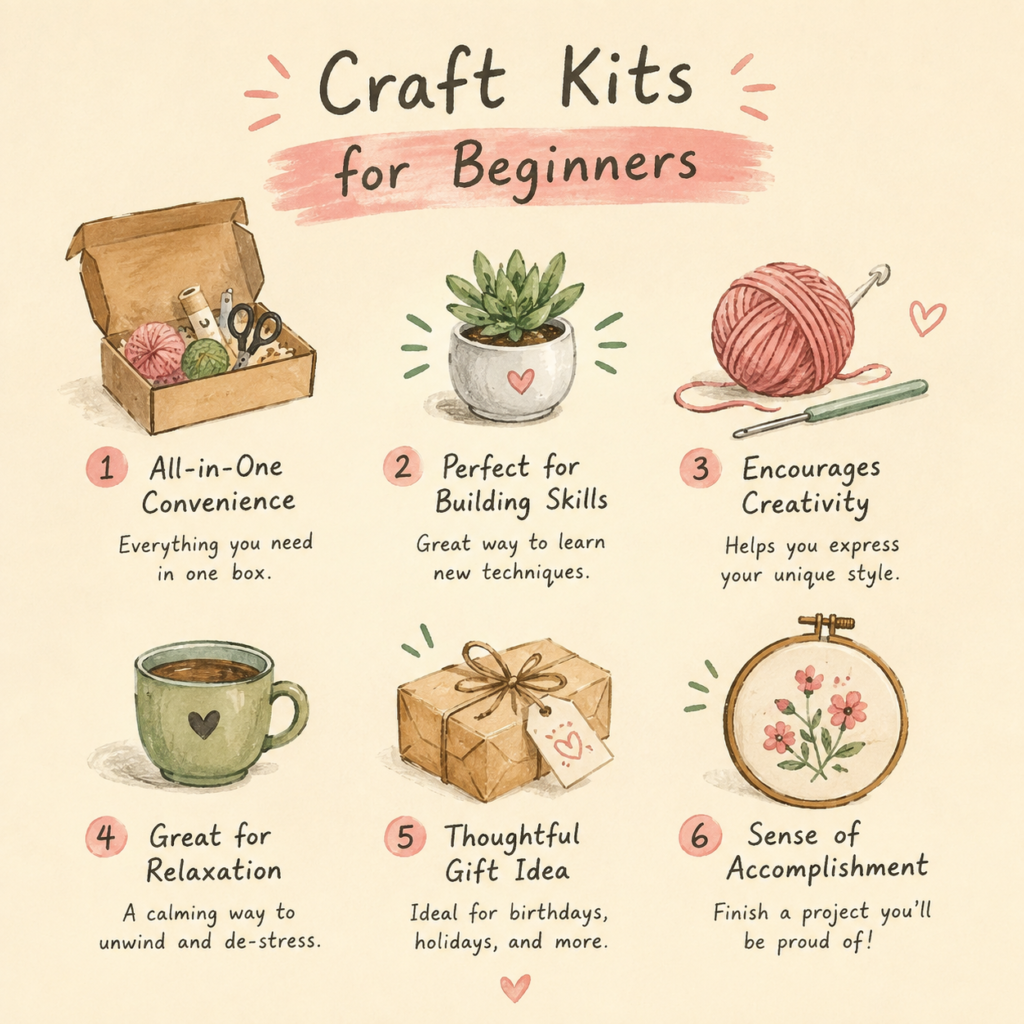
The strongest beginner kit is not necessarily the largest, cheapest, or most photogenic. It is the one that turns curiosity into a finished first project with minimal hidden friction.
Choose the creative experience first. Then verify the contents, instructions, labeling, seller, reviews, and recall status. That creates a recommendation readers can trust—and a first project they are much more likely to finish.
