10 Easy Desk Stretches for Office Workers Who Sit All Day
The modern office worker spends an average of 8-10 hours sitting at their desk, often maintaining the same posture for extended periods. This sedentary lifestyle has become so common that many people don’t realize the toll it takes on their bodies until stiffness, discomfort, or reduced mobility sets in. The good news? Simple desk stretches performed consistently throughout your workday can make a dramatic difference in how you feel, both during work hours and after you clock out.
This guide isn’t just another list of stretches to bookmark and forget. Instead, we’ll walk through practical, easy-to-implement movements that you can naturally weave into your existing work routine. Think of these stretches as cumulative investments in your physical well-being—small actions repeated daily that build toward significant long-term benefits. By the end of this article, you’ll have a complete understanding of how to transform your static workday into one punctuated with revitalizing movement breaks.
Why Movement Breaks Matter
Before diving into specific stretches, it’s essential to understand why these movement breaks are so critical for office workers. Prolonged sitting affects your body in ways that extend far beyond temporary discomfort. When you remain in a seated position for hours, your muscles adapt to this shortened state, particularly in the hip flexors, hamstrings, and chest. Your circulation slows, your metabolism decreases, and the intervertebral discs in your spine experience increased pressure.
According to research highlighted by Harvard Health, extended periods of sitting are associated with various health concerns, including increased risk of cardiovascular problems, metabolic syndrome, and musculoskeletal discomfort. The human body simply wasn’t designed for prolonged static postures—we’re built to move regularly throughout the day.
The World Health Organization recommends that adults engage in regular physical activity to counteract the negative effects of sedentary behavior. While desk stretches don’t replace dedicated exercise, they serve as crucial interruptions to prolonged sitting, helping maintain flexibility, improve circulation, and reduce muscle tension.
What makes desk stretches particularly powerful is their progressive impact. You won’t necessarily feel dramatically different after your first stretch session, but consistency is where the magic happens. After a week of regular stretching, you might notice slightly less tension in your shoulders. After a month, that persistent neck stiffness may diminish. After three months, maintaining good posture becomes easier because your muscles aren’t constantly fighting against tightness. This cumulative effect is why integrating stretches into your daily routine—not just doing them occasionally—is so important.
Neck Stretch
Your neck bears the weight of your head all day, and when you’re leaning forward to view a computer screen, that strain intensifies significantly. The neck stretch addresses the tension that builds in the cervical spine and surrounding muscles, particularly the upper trapezius and levator scapulae.
How to perform it: Sit up straight in your chair with both feet flat on the floor. Keep your shoulders relaxed and down, away from your ears. Slowly tilt your head toward your right shoulder, bringing your ear closer to your shoulder without lifting the shoulder itself. You should feel a gentle stretch along the left side of your neck. Hold this position for 15-20 seconds while breathing normally. Return your head to center, then repeat on the left side.
For a deeper stretch, you can gently place your right hand on the left side of your head (when tilting right) and apply very light pressure—the weight of your hand alone, not active pulling. This is about gentle encouragement, not force.
Duration and frequency: Perform this stretch on both sides, holding each side for 15-20 seconds. Repeat this sequence 2-3 times. Ideally, incorporate this stretch every 1-2 hours throughout your workday, especially after extended periods of screen time.
Safety precautions: Never force your neck into an uncomfortable position or use jerky movements. If you experience sharp pain, dizziness, or tingling down your arms, stop immediately. The stretch should produce a gentle pulling sensation, not pain. Avoid rolling your head in complete circles, as this can compress the cervical spine unnecessarily.

Shoulder Stretch
Shoulders tend to creep upward and forward throughout the workday, especially during moments of concentration or stress. This protective posturing creates chronic tension in the shoulder girdle and upper back. Regular shoulder stretches help counteract this forward rounding and release built-up tension.
How to perform it: Start with a shoulder roll to prepare the area. Roll your shoulders backward in a circular motion 5 times, then forward 5 times. This warms up the joint and surrounding tissues.
For the main stretch, extend your right arm across your body at chest height. Use your left hand to gently pull your right arm closer to your chest, keeping your right shoulder down and relaxed. You should feel the stretch in the back of your right shoulder and possibly into your upper back. Hold for 20-30 seconds, then switch arms.
As an additional shoulder stretch that’s perfect for desk work, try the doorway stretch: stand in your office doorway (or near a wall corner), place your forearms on each side of the doorframe with your elbows at 90 degrees, and gently lean forward until you feel a stretch across your chest and front shoulders. This counteracts the forward shoulder position from typing and mouse work.
Duration and frequency: Hold each arm stretch for 20-30 seconds and repeat 2-3 times per side. The doorway stretch can be held for 30 seconds and repeated twice. Perform these stretches mid-morning, after lunch, and mid-afternoon for optimal benefit.
Safety precautions: Don’t yank or pull aggressively on your arm. If you have a history of shoulder injuries or instability, be especially gentle. The stretch should feel like a relieving tension release, not a painful pull. Keep your neck relaxed and avoid tensing your jaw during the stretch.
Wrist Stretch
For those who type for hours daily, wrist flexibility and tension relief are crucial. The repetitive motions of typing and mouse clicking can lead to tightness in the forearm muscles and strain on the wrist tendons. These stretches provide immediate relief and, when done consistently, help maintain wrist health.
How to perform it: Extend your right arm straight out in front of you at shoulder height, palm facing up. With your left hand, gently pull back on the fingers of your right hand, bending your wrist so your fingers point toward the floor. You’ll feel this stretch in your inner forearm and wrist. Hold for 15-20 seconds.
Next, flip your right hand so your palm faces down. Use your left hand to gently press the back of your right hand, bending your wrist so your fingers point downward. This stretches the top of your forearm and wrist extensors. Hold for 15-20 seconds. Repeat on the left side.
As a complementary movement, make gentle fists with both hands and rotate your wrists in circles—10 times clockwise, then 10 times counterclockwise. This mobilizes the wrist joint and encourages synovial fluid circulation.
Duration and frequency: Hold each wrist position for 15-20 seconds per side, performing the complete sequence 2-3 times. Wrist circles can be done for 10 rotations in each direction. Because of the repetitive nature of typing, perform these stretches every hour, or more frequently if you notice tension building.
Safety precautions: Use gentle pressure only—your wrists are delicate structures with many small bones and tendons. Never stretch to the point of pain. If you experience numbness, tingling, or sharp pain, stop immediately. These stretches should feel relieving, not aggravating. If you’re experiencing persistent wrist discomfort, consider ergonomic adjustments to your workstation as well.
Back Stretch
Your spine endures significant stress from prolonged sitting, particularly in the lower back and thoracic regions. Back stretches help restore the spine’s natural curves, decompress the vertebrae, and relieve tension in the supporting muscles. This is often the stretch that office workers find most immediately relieving.
How to perform it: For a seated spinal twist, sit up tall in your chair with both feet flat on the floor. Place your right hand on the back of your chair and your left hand on your right knee. Gently rotate your torso to the right, using your hands for light support but not to force the movement. Keep your hips facing forward—the rotation should come from your mid-back, not your lower back. Hold for 20-30 seconds while breathing deeply, then repeat on the left side.
For a back extension stretch, stand up and place your hands on your lower back with fingers pointing downward. Gently arch backward, supporting your lower back with your hands. Look slightly upward but don’t crane your neck. This counteracts the forward-flexed position of sitting. Hold for 10-15 seconds.
The cat-cow stretch, adapted for office use, is also excellent: sit on the edge of your chair, place your hands on your knees, arch your back while looking slightly upward (cow position), then round your back while tucking your chin (cat position). Flow between these positions 5-8 times.
Duration and frequency: Hold the seated twist for 20-30 seconds per side, repeat 2-3 times. The standing back extension can be held for 10-15 seconds and repeated 2-3 times. The cat-cow flow should be performed 5-8 times. Incorporate back stretches every 1-2 hours, and always after prolonged periods of sitting in the same position.

Safety precautions: Never force a twist or arch your back aggressively. If you have a history of disc problems, herniation, or chronic back issues, be particularly gentle and consider consulting with a healthcare provider about appropriate stretches for your situation. Sharp pain is a signal to stop. The goal is gentle mobilization, not extreme ranges of motion.
Hip Stretch
Your hip flexors—the muscles at the front of your hips that lift your knees—remain in a shortened position throughout the workday when sitting. This can lead to tightness that affects your posture, gait, and lower back. Hip stretches are essential for maintaining mobility and preventing the adaptive shortening that comes from prolonged sitting.
How to perform it: For a seated figure-four stretch, sit in your chair and place your right ankle on your left knee, creating a “4” shape with your legs. Sit up tall and gently lean forward from your hips, keeping your back straight. You should feel the stretch in your right hip and glute area. Hold for 20-30 seconds, then switch legs.
For a standing hip flexor stretch (if you have privacy or a private office), step your right foot forward into a small lunge position. Keep your back leg straight and gently push your hips forward while keeping your torso upright. You’ll feel this in the front of your left hip. Hold for 20-30 seconds per side.
A simple seated hip circle can also help: sit near the front of your chair, lift your right knee, and make small circles with your knee—10 clockwise, 10 counterclockwise. This mobilizes the hip joint itself.
Duration and frequency: Hold the figure-four stretch for 20-30 seconds per side, repeating 2-3 times. The standing hip flexor stretch should be held for 20-30 seconds per side and repeated twice. Hip circles can be done 10 times in each direction. Perform hip stretches mid-morning, after lunch, and before leaving work.
Safety precautions: Balance is important for standing stretches—hold onto your desk or chair back if needed. Don’t bounce or force the stretch. If you have hip replacements or injuries, consult with your healthcare provider about appropriate modifications. The stretch should feel releasing, not pinching or painful.
Leg Stretch
Your hamstrings and calves tighten from prolonged sitting and from keeping your feet at 90-degree angles all day. Leg stretches improve circulation, reduce the risk of cramping, and help maintain flexibility that’s essential for overall mobility.
How to perform it: For a seated hamstring stretch, sit near the edge of your chair and extend your right leg straight out in front of you with your heel on the ground and toes pointing up. Keep your left foot flat on the floor. Sit up tall and gently lean forward from your hips (not your lower back) until you feel a stretch in the back of your right thigh. Hold for 20-30 seconds, then switch legs.
For a calf stretch, stand and face your desk or a wall. Step your right foot back, keeping it straight with your heel down. Your left leg should be bent in front of you. Lean forward gently until you feel the stretch in your right calf. Hold for 20-30 seconds, then switch legs.
For ankle mobility, which is often overlooked, sit in your chair and extend one leg. Point your toes away from you, then flex them back toward you. Repeat 10 times per foot. This pumps blood back from your lower legs and maintains ankle flexibility.
Duration and frequency: Hold hamstring and calf stretches for 20-30 seconds per side, repeating 2-3 times. Ankle pumps can be done 10 times per foot. These stretches are particularly important before standing up after long sitting periods. Perform them mid-morning, after lunch, and mid-afternoon at minimum.
Safety precautions: Keep the stretched leg relaxed—don’t lock your knee hyperextended. If you feel strain behind your knee or sharp pain, reduce the intensity. For the calf stretch, ensure your back heel stays down to get the full benefit. If you have a history of Achilles tendon issues, be especially gentle with calf stretches.
Five-Minute Desk Routine
Now that you understand each individual stretch, let’s integrate them into a practical five-minute routine that you can perform multiple times throughout your workday. This sequence is designed to flow logically from one stretch to the next, addressing your entire body in a time-efficient manner.
The Complete Sequence:
1. Seated breathing and posture reset (30 seconds): Sit up tall, feet flat on the floor. Take three deep breaths, rolling your shoulders back and down on each exhale. This centers your awareness and prepares your body for stretching.
2. Neck stretches (1 minute): Perform side neck stretches, holding each side for 20 seconds, twice per side. This addresses the upper body where tension often accumulates first.
3. Shoulder rolls and stretches (1 minute): Roll shoulders backward 5 times, then forward 5 times. Perform cross-body shoulder stretches, holding each arm for 20 seconds.
4. Wrist and forearm stretches (45 seconds): Extend each arm and stretch both the palm-up and palm-down positions for 15 seconds each, then perform wrist circles.
5. Seated spinal twist (45 seconds): Twist to each side, holding for 20 seconds per side. This mobilizes your spine and engages your core.
6. Hip figure-four stretch (45 seconds): Perform the seated figure-four stretch on each side for 20 seconds.
7. Standing back extension (15 seconds): Stand and perform a gentle back extension with hands supporting your lower back.
8. Leg stretches (1 minute): Perform the seated hamstring stretch for 20 seconds per leg, followed by ankle pumps.
This routine provides comprehensive coverage of all the major areas affected by desk work. The beauty of this sequence is its adaptability—you can perform the complete five-minute routine during designated breaks, or pull out individual stretches as needed throughout the day when you notice specific areas of tension.
Integration strategies: Set a recurring reminder on your phone or computer for every two hours to complete this routine. Many people find that performing it mid-morning (around 10:30 AM), after lunch (around 1:30 PM), and mid-afternoon (around 3:30 PM) works perfectly. If you’re in back-to-back meetings, even performing half the routine is better than skipping it entirely.
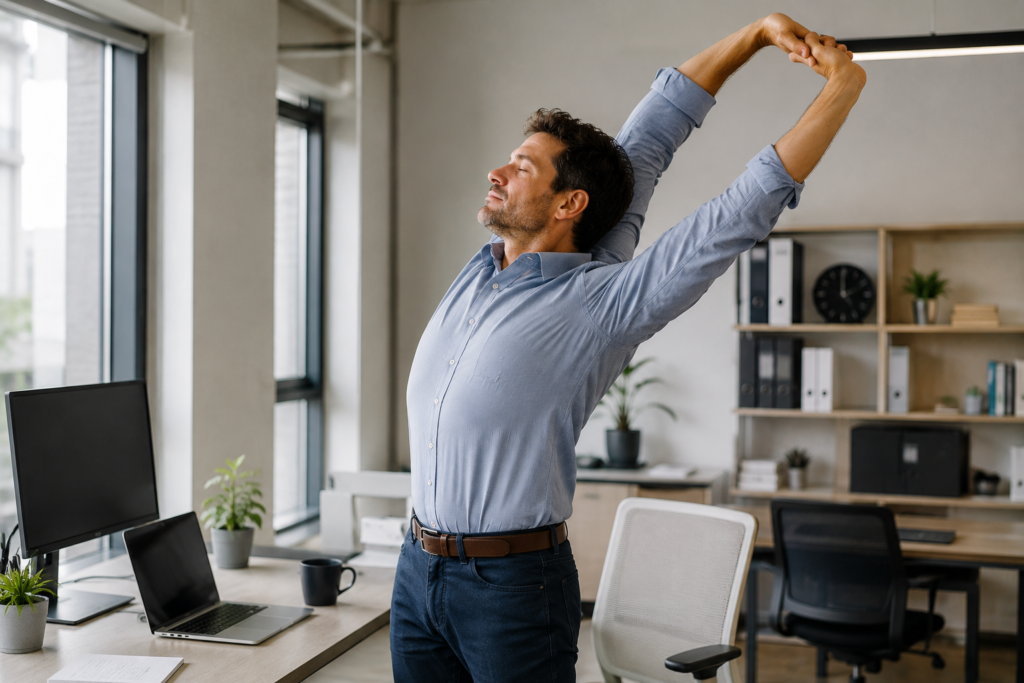
Consider pairing your stretch routine with other regular activities to build the habit: stretch after every video call, before checking your email after lunch, or immediately after your afternoon coffee. These “habit stacks” make it easier to remember and maintain your stretching practice over time.
Frequently Asked Questions
How often should I do desk stretches?
Ideally, you should incorporate some form of stretching or movement every 30-60 minutes. This doesn’t mean performing the complete five-minute routine every hour—instead, alternate between individual stretches and full sequences. A good baseline is to do quick 30-second stretches (like neck or wrist stretches) every hour, with more comprehensive 3-5 minute routines every 2-3 hours. The key is consistency rather than duration. Brief, frequent movement breaks are more effective than occasional long stretching sessions.
Can desk stretches really prevent back pain?
Desk stretches are an important component of maintaining back health, but they work best as part of a broader approach that includes proper ergonomics, good posture habits, and regular exercise. Stretches help by maintaining flexibility, reducing muscle tension, and promoting circulation to the tissues supporting your spine. They can significantly reduce discomfort and may help prevent minor issues from developing into chronic problems. However, if you’re currently experiencing persistent back pain, stretches alone may not be sufficient—consider consulting with a healthcare provider for a comprehensive evaluation and treatment plan.
Are there any stretches I should avoid at my desk?
Avoid any stretches that require extreme ranges of motion or that cause pain. Full head circles (rolling your head in complete circles) can compress the cervical spine and are generally not recommended. Avoid ballistic stretching (bouncing movements) as these can cause injury. If you have specific conditions like herniated discs, joint replacements, or recent injuries, certain stretches may not be appropriate for you. When in doubt, start gently and conservatively, and consult with a healthcare provider or physical therapist about which stretches are safe for your individual situation.
What’s the best way to remember to take stretch breaks?
Technology can be your ally here. Set recurring calendar reminders, use browser extensions designed for break reminders, or try apps specifically created for office workers that prompt movement breaks. Some people find success with the Pomodoro Technique—working in focused 25-minute intervals with 5-minute breaks, using those breaks for stretching. Physical cues also work well: place a sticky note on your monitor, keep a stress ball on your desk as a visual reminder, or set your water bottle across the room so you must stand and walk to take a drink (combining hydration with movement). The best system is one that fits naturally into your workflow rather than feeling like an interruption.
Do I need special equipment for desk stretches?
No special equipment is required for the stretches described in this article. They’re all designed to be performed with just your body and your office furniture (chair and desk). That said, some people find that small accessories enhance their stretching practice: a resistance band for assisted stretches, a small foam roller for self-massage, or a foot rest to improve positioning. However, these are optional additions, not necessities. The most important equipment you have is your own awareness and commitment to taking regular breaks. The simplicity and accessibility of desk stretches are actually advantages—you can perform them anywhere, anytime, without needing to change clothes, find equipment, or leave your workspace.
Building Your Stretching Habit
Knowing how to stretch is only half the equation—building a sustainable habit is equally important. Research on habit formation suggests that it takes an average of 66 days for a new behavior to become automatic. During this initial period, consistency matters more than perfection.
Start with just one or two stretches that address your most problematic area. If your neck is constantly tense, commit to neck stretches every two hours. Once this becomes natural, add another stretch to your routine. This gradual approach prevents overwhelm and increases your likelihood of long-term success.
Track your progress in a simple way: mark off days on a calendar when you complete your stretches, or keep a brief log noting how your body feels before and after stretching sessions. Many people are surprised to discover measurable improvements in flexibility, reduced pain levels, and enhanced energy when they review their records after several weeks.
Remember that occasional missed sessions are normal and don’t derail your overall progress. If you skip your stretches one day, simply resume the next. The cumulative benefit comes from what you do most of the time, not from being perfect all of the time.
Conclusion
Desk stretches for office workers aren’t just nice-to-have additions to your workday—they’re essential maintenance for bodies that spend most of their waking hours in seated positions. The ten stretches and integrated routine outlined in this article provide you with practical, immediately applicable tools to counteract the physical stress of prolonged sitting.
The progressive impact of these stretches is where their true value lies. Each stretch session is a small deposit into your physical health account, and like compound interest, these deposits accumulate into significant returns over time. A few minutes of stretching today might seem insignificant, but those same minutes repeated daily for months transform your flexibility, reduce chronic tension, and help you feel more comfortable and energized throughout your workday.
Your body is designed to move, and even within the constraints of office work, you can honor that design through regular, mindful movement breaks. Start today with just one stretch during your next work break. Your future self—more flexible, less tense, and more comfortable—will thank you for the investment.